Farm and agricultural restrooms in Waldorf run on the same field sanitation rule that covers hand-labor crews anywhere: one facility per 20 workers, reachable within a quarter mile walk, under OSHA 1928.110. A single standard unit handles a small crew; larger harvest operations need more units spread across the property.
Start with the crew count, not the acreage. OSHA 1928.110 sets the baseline for agricultural hand-labor employees at one facility per 20 workers, and it has to sit within a quarter mile walk of wherever people are working, so a 200 acre operation with crews spread over several fields may need multiple units placed near each work zone rather than one unit at the barn. Waldorf farms running seasonal harvest crews, tobacco or produce operations, or livestock work all fall under the same walk-distance rule. If you are unsure how many stalls to bring for a mixed crew of pickers and equipment operators, our porta potty needs guide walks through the math, and the general OSHA portable toilet requirements page covers the construction-side ratio under 1926.51(c) for comparison, since some farms also run building projects concurrently. A standard porta potty rental with its 60 to 70 gallon tank covers a crew of that size for a week between services under the ANSI/PSAI Z4.3 baseline interval. Potable water matters too: OSHA 1926.51(a)(1) requires an adequate supply wherever people are working, which is why we pair units with handwashing station rental or a simple portable sink rental on request. Waldorf Porta Pros delivers to fields across the property, not just the yard, and placement follows the same quarter mile logic whether it is a tobacco barn or a produce stand. For farms closer to Brandywine, 6.9 miles north, or Bryantown, 8.0 miles southeast, the same delivery routes apply, and you can check service areas for the full coverage map.
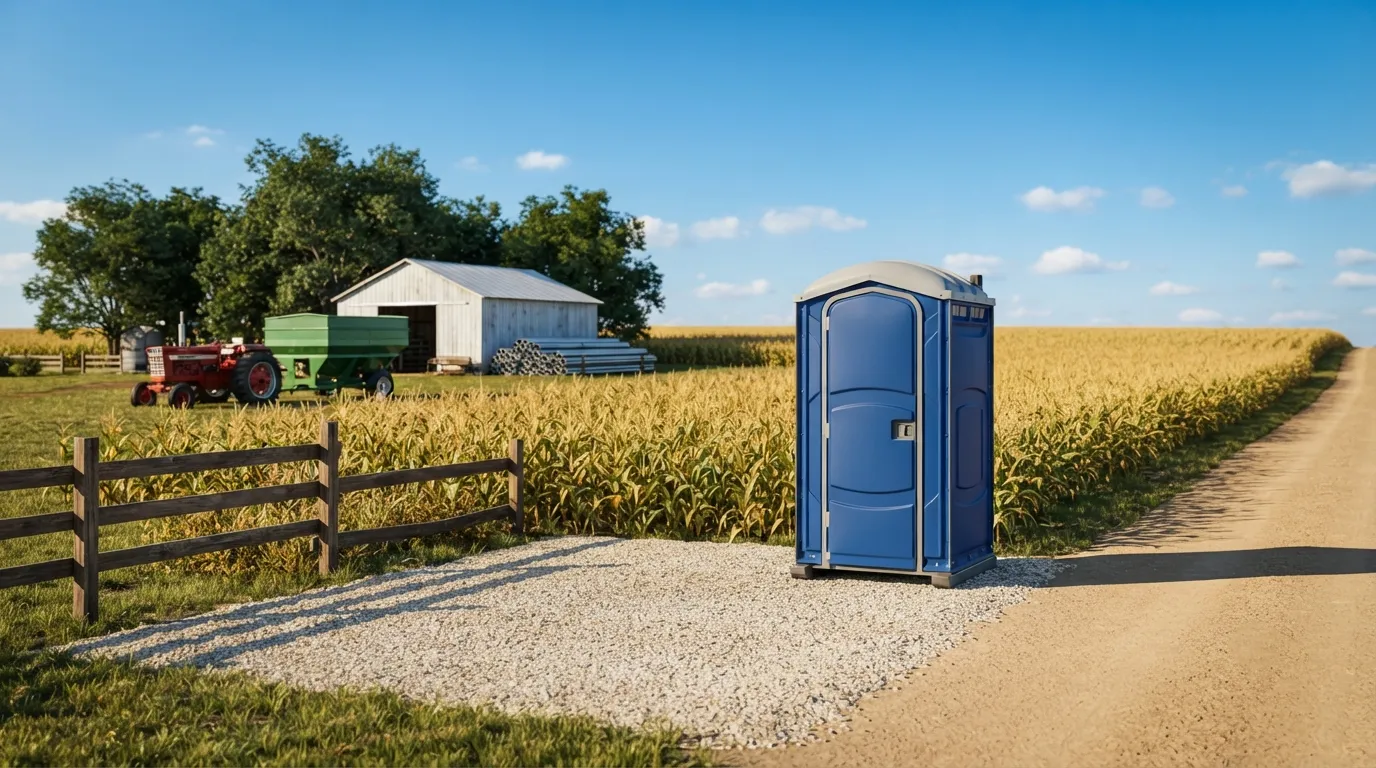
A standard unit is the workhorse: about 44 by 48 inches on the ground, 92 inches tall, and built for rough placement on dirt or gravel without a hookup. That footprint fits along a fence line, next to a barn, or at the edge of a field where a truck can reach it. For farm labor housing or longer seasonal contracts, monthly porta potty rental pricing beats booking week to week, and the table below shows how the math works out.
| unit | day | week | month |
|---|---|---|---|
| standard | $100 - $350 | $130 - $500 | $125 - $325 |
| deluxe | $85 - $1200 | $150 - $290 | - |
| ada | $200 - $400 | $240 - $400 | - |
If the operation employs anyone with a mobility limitation, at least one unit in a cluster needs to meet ADA Standards section 213.2, which requires 5 percent of clustered units, and never fewer than one, to be accessible. An ADA accessible porta potty needs a 60 inch turning circle inside per ADA Standards 304.3.1 and a 32 inch clear door opening under section 404.2.3, so it needs firmer, more level ground than a standard unit tucked against a fence post. Farms doing produce washing, equipment cleanout, or pesticide application should also look at handwashing separately: OSHA 1926.51(f)(1) requires washing facilities specifically where workers apply pesticides, herbicides, or other contaminants, and a sink or station covers that need without over-specifying the whole crew's sanitation. For operations that also run a farm stand or agritourism event, our farm and agricultural restrooms page pairs naturally with county fair restrooms or event restroom rental planning for the busy season. Septic support matters too if the farmhouse has its own system: a typical 1,000 gallon residential tank gets pumped every 3 to 5 years depending on household size, and septic pumping service or how often to pump a septic tank covers that separately from field sanitation.
Permit rules for placement vary by property and by whether the unit sits in a right of way or on private farmland, so confirm placement with the city before delivery. Most farm placements sit well off any public road, but if a unit needs to go near a shared driveway or road frontage, check porta potty permit requirements first. Waldorf Porta Pros handles delivery logistics either way, including tight field access, and a roll-off dumpster rental or construction dumpster rental often rides along on the same trip when a farm is clearing brush, fencing, or old equipment. Temporary fencing also comes up around livestock pens or event areas; see temporary fence rental for options. For grease or wash-water from a farm kitchen or processing shed, grease trap pumping follows a different rule: a grease interceptor gets pumped once fats, oils, grease and solids reach 25 percent of the liquid depth, which is unrelated to field toilet placement but often gets asked about in the same call.
Book two to three weeks ahead if possible, since harvest season demand stacks up fast across Waldorf and nearby farms. Emergency delivery is available; see emergency porta potty rental for short-notice options when a crew shows up sooner than expected.
Only if every field sits within the quarter mile walk OSHA 1928.110 requires. Fields farther apart need separate units placed near each work zone, not one central unit for the whole property.
Once a crew passes 20 workers, OSHA 1928.110 calls for an additional facility. A 45 person picking crew typically needs three units spread across the work area, not stacked at one spot.
No. Standard units are self-contained with a 60 to 70 gallon tank and work fine on dirt, gravel, or grass. Water access only matters for handwashing stations, which run separately.
Weekly service is the baseline under ANSI/PSAI Z4.3 for typical use levels. Heavy crews or extended harvest runs may need twice-weekly service; ask about a custom schedule when you book.
Yes. Waldorf Porta Pros delivers farm and agricultural restrooms across Waldorf and the surrounding metro, with same-day and next-day drop-off available on most orders.
Pricing depends on the unit and how long you need it. See our cost breakdown and request a free quote for an exact figure.
Standard rentals include scheduled service — a pump-out, a clean, a restock and fresh deodorizer. Busy or hot-weather sites can be serviced more often.
Call now or request a free quote — clean units, on-time delivery, transparent pricing.