A county fair in Waldorf needs one toilet per 20 attendees under peak crowding, plus at least one ADA unit per cluster under ADA Standards 213.2. Waldorf Porta Pros builds fair-scale restroom plans around gate counts, midway layout and hours open, not guesswork.
Start with attendance, not acreage. OSHA 1926.51(c) sets construction-site ratios, but fairs run on crowd density instead: figure one standard unit per 20 to 30 guests per peak hour, then add units near food vendors and grandstands where lines form fast. A three-day fair pulling steady crowds usually needs more coverage than a single Saturday event, so event restroom rental planning should start with your gate projections, not a flat number pulled from memory. Waldorf fairgrounds with grandstands, livestock barns and a midway all draw foot traffic differently, and each zone needs its own cluster instead of one bank of units by the entrance.
Ground conditions matter too. A standard porta potty rental sits on a 44 by 48 inch footprint and stands about 92 inches tall, so uneven ground or a slope near a barn aisle changes where units can go. For events expecting families and elderly visitors, at least one ADA accessible porta potty per cluster is required under ADA Standards 213.2, with a 60 inch turning circle inside per ADA Standards 304.3.1. If your fair runs food trucks and a beer garden, pair toilets with a handwashing station rental near every food zone, since attendees expect a sink close to where they eat, not fifty yards across the field.
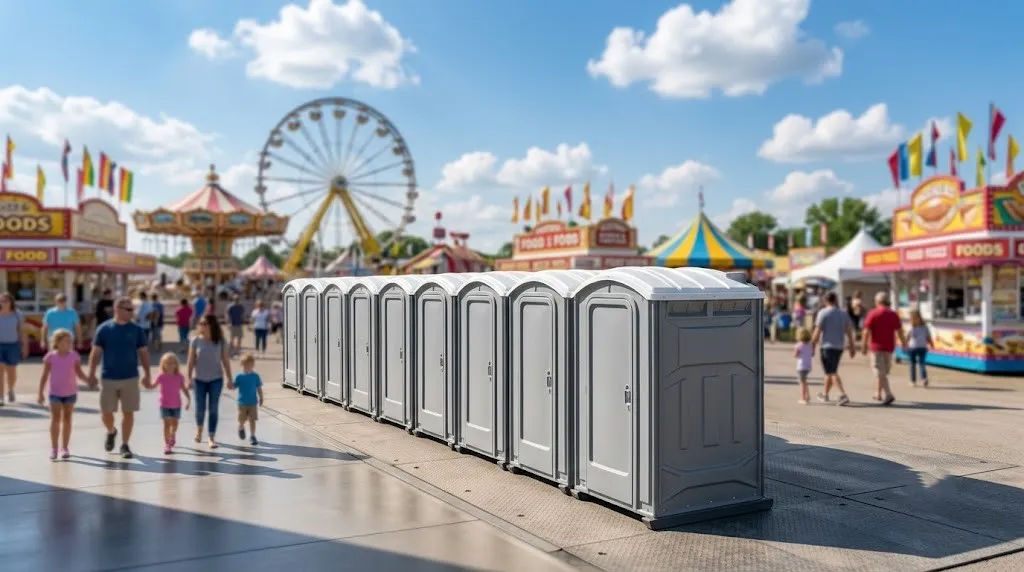
Fair pricing runs by event, not by the day, because setup, service visits over multiple days and teardown all factor in. A standard unit rented for a multi-day event typically falls between 200 and 800 dollars for the run, while an ADA unit rents by the day between 200 and 400 dollars depending on demand. Deluxe flushable units for VIP areas or sponsor tents run higher. See the porta potty rental cost breakdown for how event pricing differs from daily or weekly rates.
| unit | duration | low | typical | high |
|---|---|---|---|---|
| standard | event | 200 | 400 | 800 |
| trailer | event | 2499 | 3500 | 3899 |
| ada | day | 200 | 230 | 400 |
| deluxe | day | 85 | 300 | 1200 |
For fairs with a sponsor row or a beer tent, a luxury restroom trailer or an 8 stall restroom trailer handles heavier traffic better than a line of standalone units. A 4 stall restroom trailer works for smaller fair footprints, like a single livestock barn event or a youth exhibit hall. Delivery fees stack on top of unit cost and typically run 100 to 500 dollars depending on distance and access, so ask about that separately from the unit price shown in any quote.
Placement decides whether lines back up into walkways or stay contained. Units need a stable, firm, slip-resistant surface under ADA Standards 302.1, so grass that turns to mud after a Waldorf rain isn't a safe pad without matting or gravel underneath. Service trucks need roughly 60 feet of straight clearance for delivery and pumping, which rules out tight spots between livestock trailers or wedged behind a stage. Walk the site with our porta potty placement guide before the fair, not the morning gates open.
Cluster restrooms in twos or threes near high-traffic zones: main gate, grandstand exits, food court, livestock barns. Keep at least one ADA unit per cluster with a 32 inch clear door opening per ADA Standards 404.2.3 and a 36 inch accessible path per ADA Standards 403.5.1 leading to it. Fairs running past dusk should also plan lighting near restroom clusters, and a light tower rental or an emergency generator through temporary power pole service keeps those paths visible. If crowd flow needs steering, pair restroom zones with a crowd control barrier rental so lines don't spill into vendor aisles. Waldorf fairs pulling regional crowds from Brandywine, 6.9 miles north, or La Plata, 8.7 miles southwest, tend to see heavier Saturday peaks, so plan extra units for that day specifically.
Fairs also generate trash fast between food vendors and exhibit teardown. A roll-off dumpster rental alongside your restroom cluster keeps the grounds clean without extra hauling trips. For fencing off restroom zones or staging areas, a temporary fence rental or chain link temporary fence keeps foot traffic where you want it.
Book as early as your venue contract allows, ideally 60 to 90 days out for a multi-day county fair. Fair season books trailers and ADA units fast across Waldorf and nearby towns like Accokeek, 8.3 miles northwest. Waiting until two weeks out limits you to whatever standard units remain.
Yes, especially near food vendors. Under 29 CFR 1910.141(d)(2), handwashing needs soap and towels or a hand-drying device, not just sanitizer. A portable sink rental placed near food booths meets that need better than a single unit shared across the whole fairgrounds.
Yes, most restroom trailers run self-contained with onboard water and holding tanks. Ask about generator needs for lighting and pumps if your fairgrounds site has no power drop nearby, since that changes delivery setup and timing.
A standard unit is a single-stall unit on a 44 by 48 inch base, best for spread-out clusters. A restroom trailer rental has multiple stalls, sinks and often climate control, better suited to grandstand areas or VIP sections with heavier steady traffic.
Service frequency depends on attendance, but a common baseline is at least once daily during a multi-day fair, more often near food courts. Ask your provider to schedule service around gate hours so trucks aren't blocking midway access during peak crowds.
Yes. Waldorf Porta Pros delivers county fair restrooms across Waldorf and the surrounding metro, with same-day and next-day drop-off available on most orders.
Pricing depends on the unit and how long you need it. See our cost breakdown and request a free quote for an exact figure.
Standard rentals include scheduled service — a pump-out, a clean, a restock and fresh deodorizer. Busy or hot-weather sites can be serviced more often.
Call now or request a free quote — clean units, on-time delivery, transparent pricing.