Race day restrooms for a Waldorf marathon or 5k need one toilet per roughly 50 to 100 runners at start and finish, plus extra units at aid stations past mile 3. Waldorf Porta Pros builds the count around your route map, your runner field, and your city permit window, not a guess.
Start with the corral. A field of 500 runners waiting to start wants 8 to 10 standard units clustered near the line, not spread thin. Standard porta potty rental covers that base load, and each unit holds a 60 to 70 gallon tank, enough for a few hours of heavy pre-race use without a mid-morning service call. Finish line traffic is worse than the start, because runners funnel in over two or three hours instead of five minutes. Plan for double the start count at the finish.
Aid stations along the course need their own units too, spaced at water stops past mile 3 where runners are more likely to need a bathroom mid-race. A marathon looping through Waldorf might place clusters near mile 6, mile 13, and mile 20. If you are not sure how the math works out for your field size, how many porta potties do I need walks through the ratio in more detail, and our event restroom rental team will run the count against your actual course map. Every cluster also needs at least one accessible unit under ADA Standards section 213.2, which requires 5 percent of any grouped set, minimum one, to meet accessible specs.
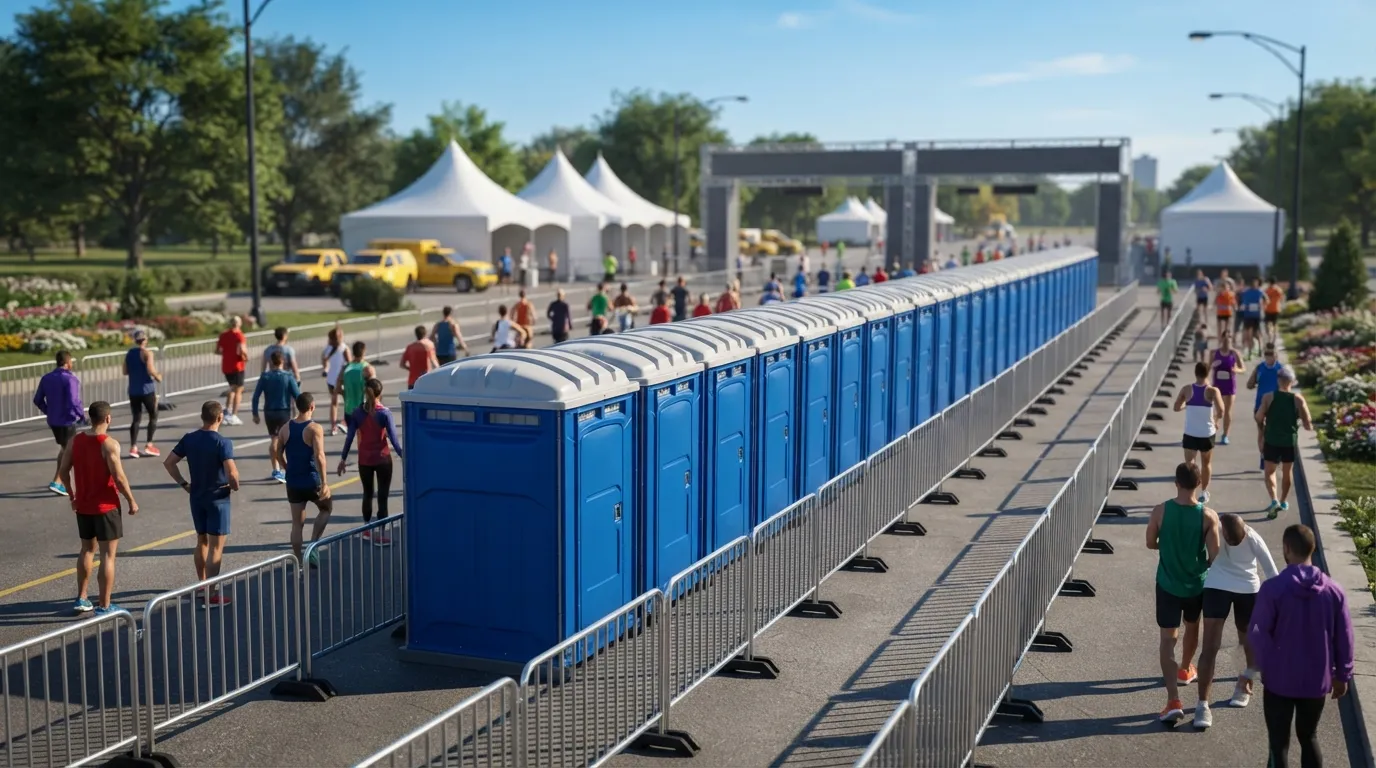
Placement follows the same logic as any large event: firm ground, clear truck access, and a route that does not cross the runner lane. ADA Standards section 302.1 calls for stable, slip-resistant surfaces, which matters on grass infields that get soft after a wet week. A service truck needs roughly 60 feet of straight clearance to spot a unit or swap a tank, so aid station placement has to account for a pull-through, not just a parking spot.
Race organizers running timing equipment, PA systems, or lit start corrals at dawn often need a temporary power pole alongside the restroom cluster. Knowing how to brace a temporary power pole matters here: the pole needs a stable base plate or guy-wired support so wind or a jostled cable doesn't tip it near a crowd of runners. Pair that with a light tower rental for early starts before sunrise, and route both away from the runner lane and any accessible unit's turning space, since ADA Standards section 304.3.1 requires a 60 inch clear turning circle at accessible units.
For races with a VIP tent, staff area, or sponsor hospitality zone, a deluxe flushable porta potty or a full restroom trailer rental upgrades the experience without adding much footprint. An 8 stall restroom trailer handles staff and volunteer traffic at a finish line festival well after the last runner crosses.
Pricing depends on unit count, event length, and whether you need same-day servicing during the race itself. Most single-day races run on standard units at event-day rates, while multi-day festivals or stage races price closer to a weekend or weekly band.
| Unit type | Day rate | Notes |
|---|---|---|
| Standard unit | $200 to $800 | Event-day rate, single day, per unit range across busy race weekends |
| ADA accessible | $200 to $400 | Required at every cluster per ADA Standards 213.2 |
| Deluxe flushable | $85 to $1200 | VIP or staff zones, wide range depending on package |
| Delivery fee | $100 to $500 | One-time, covers drop and pickup |
Ask about a request a quote built around your exact runner count and course length, since a half-marathon field of 300 prices very differently than a full marathon field of 3,000. Full porta potty rental cost breakdowns and porta potty rental per day numbers give more context if you're comparing against a multi-day county fair or festival budget instead.
Race organizers in Waldorf should also check placement rules before locking a route, since public right-of-way sections may need city sign-off; confirm with the city on any road-crossing restroom placement rather than assuming a blanket permit covers it. Our porta potty permit requirements guide covers what to ask before race day.
Book 4 to 6 weeks out for anything over 500 runners, since large clusters need trucks staged and units pulled from inventory across a busy race season. Smaller local 5ks can often book 2 weeks out. Waldorf races clustered around fall weekends fill fastest.
No. Aid stations past mile 3, spaced every 5 to 7 miles, cover most marathon courses well. Shorter 5k and 10k races usually only need start and finish clusters, no mid-course units at all.
Units can be repositioned before the race starts, but not once runners are on course. Confirm your final route map with Waldorf Porta Pros at least a week out so placement locks in ahead of the gun.
A servicing truck can swap tanks or restock supplies between waves if access allows it. Build a 60 foot clearance into any aid station plan so a truck can reach the unit without crossing the runner lane.
Yes. Post-race festivals draw runners, families, and vendors for hours after the last finisher, often doubling the crowd at the finish cluster. Add a few portable restroom rental units and consider a small trailer for staff.
Yes. Waldorf Porta Pros delivers marathon and race restrooms across Waldorf and the surrounding metro, with same-day and next-day drop-off available on most orders.
Pricing depends on the unit and how long you need it. See our cost breakdown and request a free quote for an exact figure.
Standard rentals include scheduled service — a pump-out, a clean, a restock and fresh deodorizer. Busy or hot-weather sites can be serviced more often.
Call now or request a free quote — clean units, on-time delivery, transparent pricing.